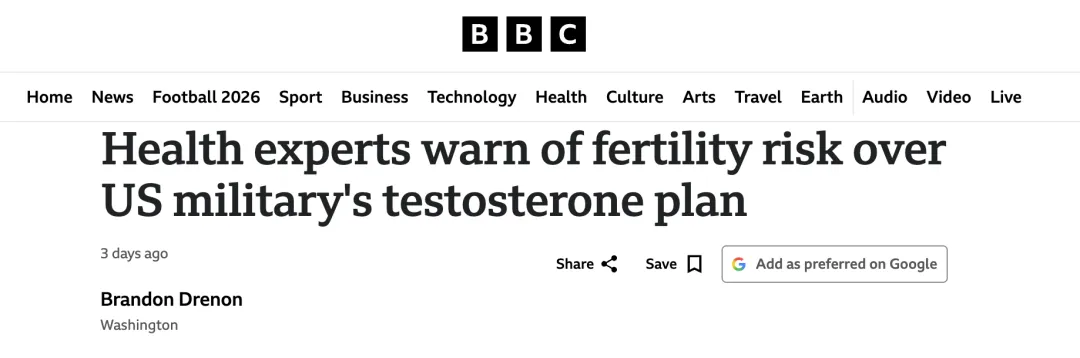
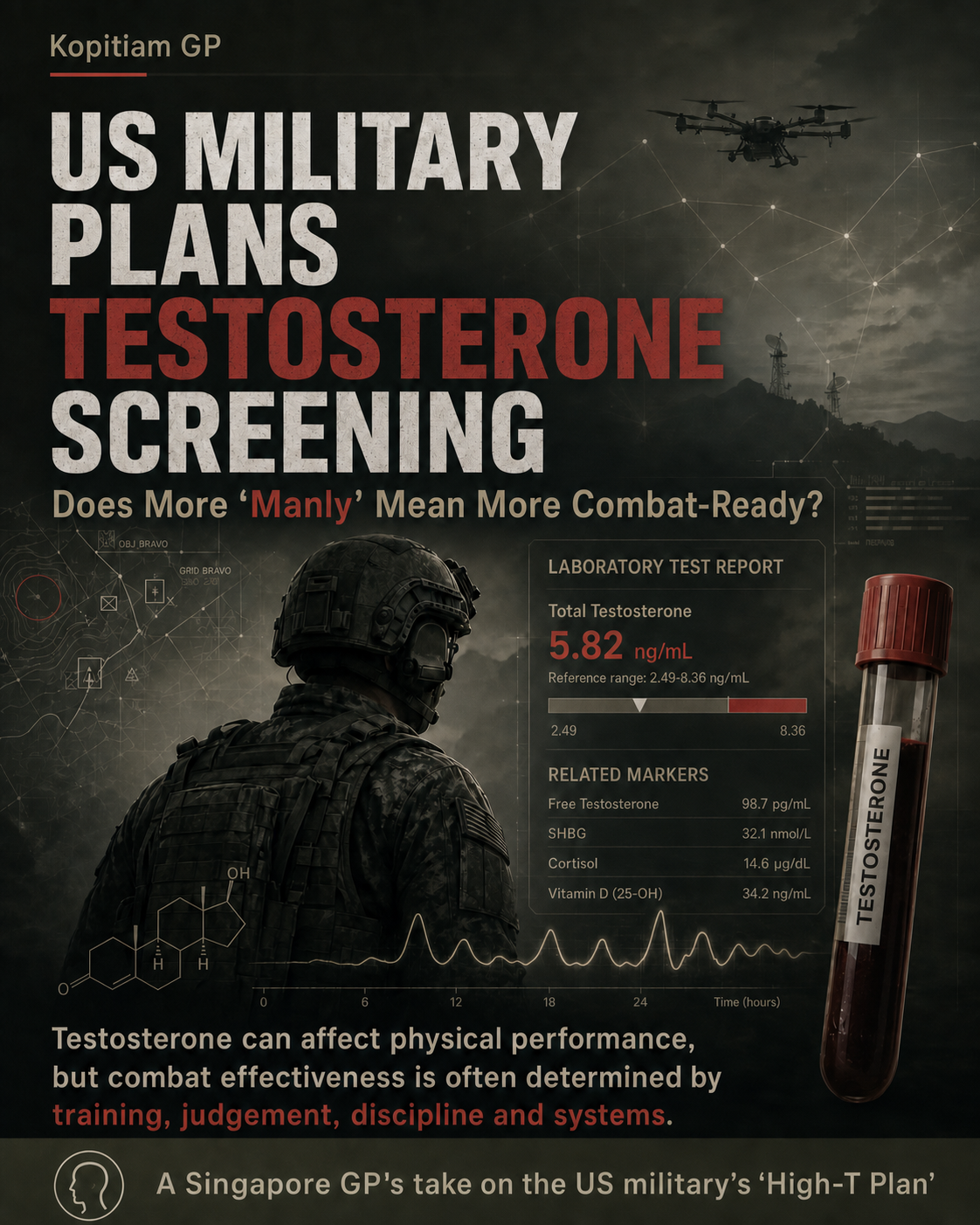
A few days ago, I saw a news report: the US military is preparing to include screening for testosterone deficiency in service members’ health assessments, with active-duty and reserve personnel aged 30 and above to be tested.
Many people’s first reaction is probably:
Does whether a man is “man” enough really affect combat capability?
In clinic, male patients also often wonder whether their testosterone is too low because they are tired, gaining abdominal fat, or not seeing results from training. Some very muscular gym-goers ask whether they can use hormones to gain more muscle. I will expand on that later.
Testosterone matters, but it is not an index of masculinity
Testosterone affects muscle mass, bone density, red blood cell production and sexual function. It can also affect some people’s energy and recovery.
If someone genuinely has hypogonadism, they may develop loss of muscle, anaemia, reduced bone density and persistent fatigue.
For soldiers who need to march with loads, carry equipment and drag injured personnel to safety, these problems may of course affect work performance.
So there is medical logic in the US military paying attention to testosterone.
Its approach is to manage service members as high-performance athletes: sleep, nutrition, fitness, recovery and hormone levels are all included in assessment, to identify problems affecting operational readiness early. Military documents call this approach “human performance optimisation” and also mention health problems that may arise from long-term stress, head impacts and overtraining.
Why is the military focusing specifically on testosterone?
The reason may be practical: it is easy to measure and easy to put into a management system.
The military likes numbers.
Running speed, waist circumference and how much weight someone can carry can all go into a spreadsheet. Testosterone is the same: one tube of blood produces a result that appears very clear.
Compared with “Have you been recovering well recently?” or “Have you been constantly tired?”, a laboratory number is easier to count and easier to build standards around.
And among special forces personnel and those under sustained heavy workloads, severe sleep deprivation, inadequate calories, blast exposure and prolonged stress may indeed accompany hormonal abnormalities.
So I think testosterone testing is reasonable for people with symptoms or high risk.
The question is what to do after finding a low result.
Low testosterone is sometimes only the body sounding an alarm
The most difficult part medically is this:
Low testosterone may be the problem itself, or it may simply be the result of the body being overdrawn for a long time.
Obesity, inadequate sleep, poor nutrition, overtraining, chronic stress and some medicines can all lower testosterone.
It is a little like a warning light on a car dashboard.
When the warning light comes on, the engine needs checking; turning off the light does not fix the car.
What really needs addressing may be sleep, diet, training arrangements, brain injury or another illness, rather than immediately replacing testosterone because a value is low.
The Endocrine Society also states that there is currently insufficient evidence to support universal screening of all asymptomatic men. Diagnosing testosterone deficiency cannot rely on a single test result: symptoms must be considered, blood should be drawn properly in the morning and testing repeated, while reversible causes are excluded.
The Olympics tests testosterone too, but it is not testing the same thing
Competitive sport likewise recognises that external testosterone may improve muscle mass, strength and recovery, so the World Anti-Doping Agency lists it as a prohibited anabolic substance.
However, the Olympics is not looking for “who has the highest testosterone”.
It tests whether athletes have artificially raised hormone levels through injections, gels or other means to gain an unfair advantage.
Put simply, the Olympics worries that someone has secretly modified the engine; the US military wants to know whether its own engine has a problem.
Both illustrate one point: testosterone does affect some aspects of physical performance, but higher is certainly not always better.
What about female soldiers, then?
On average across groups, men generally have greater muscle mass, upper-body strength and load-carrying capacity.
In physically demanding roles such as infantry, artillery and casualty evacuation, men do have an average advantage.
But an average cannot be used to judge every individual.
Some female soldiers are stronger, calmer and more able to complete the task than many male soldiers.
Modern warfare has also long been about more than who is physically strongest. Drones, cyber warfare, intelligence analysis, medical care, communications, logistics and command rely more on technical skill, judgement, discipline and teamwork.
The genuinely fair approach is neither to look first at sex nor at testosterone, but to set practical standards for the role:
How many kilograms must be carried, how far, and how quickly an injured person must be dragged to safety.
Meet the standard, and the person can do the job.
Fail to meet it, and regardless of sex, the person should not be forced into the role because of political slogans or impressions about gender.
My view
Testosterone testing by the US military has medical and management logic.
For service members with symptoms, who have long been under heavy workloads, or who may have a hormonal disorder, a proper assessment is reasonable.
But whether expanding screening to all service members aged 30 and above can improve the combat capability of the entire force remains very difficult to say.
My greater concern is whether testosterone will gradually be packaged as an indicator of masculinity, or even become a symbol of whether a military is tough.
Modern warfare certainly needs physically strong people.
But technical capability, psychological resilience, judgement, discipline, logistics and coordination across the whole system are usually more important than one hormone report.
A person’s testosterone result can look very good.
When something really goes wrong, whether that person knows what to do, can follow orders and can work with teammates is another matter.
A strong military needs tough people, but it cannot rely only on tough people to hold everything up.
Author’s note: personal views only, for reference.
Sources and scope
The authoritative pages below were checked at the time of import to clarify the policies, medical advice or professional rules discussed here; they do not constitute comprehensive endorsement of every view in this article.
Be the first to add a thoughtful comment.