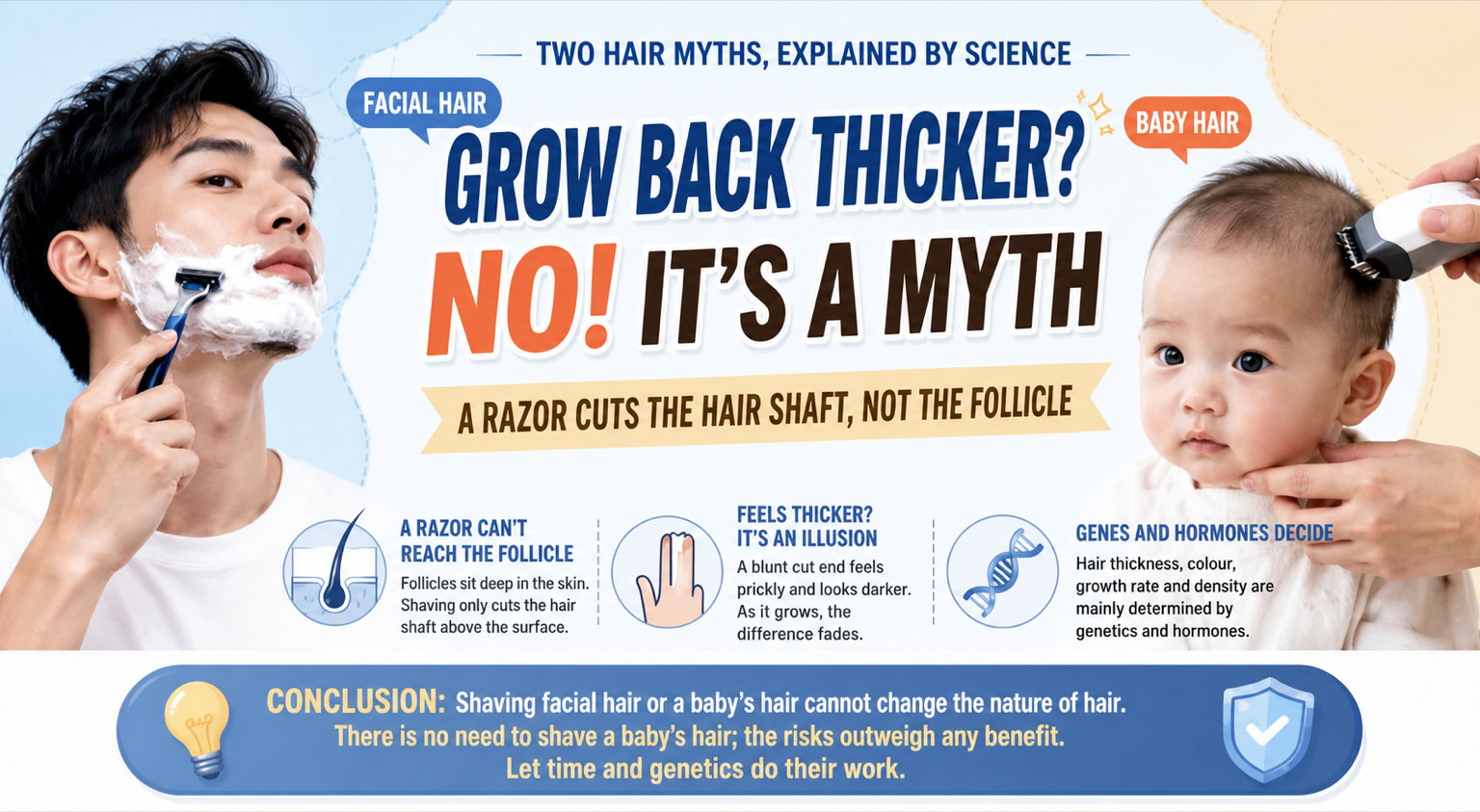
In clinic, some questions cross age, sex and three generations of a family group chat.
A teenage boy asks: “Doctor, if I start shaving now, will my beard grow thicker in the future?”
A new mother asks: “Should we shave the baby’s birth hair? The older generation says that if we do not shave it, the baby’s hair will not grow well later.”
One worries about having too much hair; the other worries about having too little.
But the misunderstanding behind both is actually the same: everyone thinks the razor is far more capable than it really is.
First, the answer: shaving does not make hair thicker or more abundant
Whether you are shaving facial hair or a baby’s head, the razor cuts only the hair shaft visible above the skin.
What really determines the number, thickness, colour and growth rate of hairs is the follicle hidden beneath the skin, together with genetics, hormones and the hair growth cycle.
Put simply, the razor is responsible only for renovating the floor above. It cannot even enter the basement machine room. It can neither increase the number of follicles nor send them a notice saying, “From today onwards, work harder and increase production.”
As early as 1928, Mildred Trotter studied the relationship between shaving and hair growth. A controlled experiment in 1970 was even more direct: researchers had young men shave only one leg for several months while leaving the other unshaven. They found no significant difference between the two sides in hair width, growth rate or total amount.
Why does hair genuinely feel thicker after shaving?
Because naturally grown hair usually tapers gradually at the tip.
A razor cuts straight across it, turning the original pointed tip into a flat cross-section. When the hair first grows out, this blunt end feels more prickly and looks more obvious, as though it has suddenly been “upgraded and thickened”.
But the hair itself has not changed. As it continues to grow longer, the visual and tactile difference becomes less noticeable.
There is another layer to the misunderstanding among teenagers.
Many boys first start shaving just as they enter puberty. Androgen levels are rising, and their facial hair would naturally become thicker, darker and denser over time.
So the sequence can appear to be:
Start shaving - the beard becomes increasingly thick.
But the real logic is usually:
Enter puberty - shaving becomes necessary, and the beard also naturally becomes increasingly thick.
The razor merely happened to pass by, yet it has carried the blame for decades.
So should a baby’s birth hair be shaved?
If “birth hair” here means the hair on a baby’s scalp at birth, shaving it will likewise not make the hair that grows later thicker or denser.
Paediatric sources also state clearly that the texture and growth rate of infant hair are mainly determined by genetics and the baby’s own growth cycle. The most certain result after shaving is not a head of thick, luxuriant hair, but a bald baby first.
However, one point needs to be stated accurately.
The claim that “shaving once will damage the follicles and stop hair from growing in the future” is also somewhat exaggerated. Normal shaving usually touches only the surface of the skin and does not cut directly into the deeper hair follicles.
The real problem is that a baby’s scalp is delicate, and the baby will not sit still and cooperate. Using a razor directly against the skin can easily cause irritation and cuts, which may then lead to a local infection.
So shaving is not recommended, not because “one pass of the razor will completely destroy the follicles”, but because it offers no clear benefit while needlessly increasing the risk of skin injury.
There is another kind of true fetal hair: lanugo
In medicine, lanugo is the fine, soft hair that grows on a fetus in the womb. It is commonly seen on the back, shoulders, ears or sides of the face, and may be more obvious in premature babies.
This hair naturally falls out gradually before or after birth. It usually does not need to be rubbed off, plucked or shaved. Trying to remove it forcibly may instead irritate a baby’s sensitive skin.
My view
Some families treat shaving a baby’s birth hair as a full-month ceremony. It is a cultural custom, and there is no need to make too much of the custom itself.
But the ritual can be kept; the risk does not need to be.
If you really want to keep a lock of hair as a memento, you can trim a little with safe round-tipped scissors or electric clippers fitted with a guard when the baby is settled. There is no need to use a blade against the scalp and shave it gleaming clean.
From the perspective of ordinary parents, everyone simply hopes that their child will have thicker hair and grow well in the future. That feeling is entirely understandable.
It is just that hair follicles do not really understand the good intentions of their elders, nor will they suddenly start working harder because they have been shaved once.
The beard that is meant to grow will grow, and the baby’s hair that is meant to be replaced will be replaced.
They mainly follow the arrangements of genetics, hormones and the growth cycle. They do not really take instructions from a razor.
Author’s note: Personal opinion, for reference only.
Be the first to add a thoughtful comment.