A medical news story has attracted a lot of attention over the past couple of days.
The individualised mRNA cancer vaccine developed by Moderna and Merck has delivered positive topline results in a Phase 3 clinical trial in melanoma.
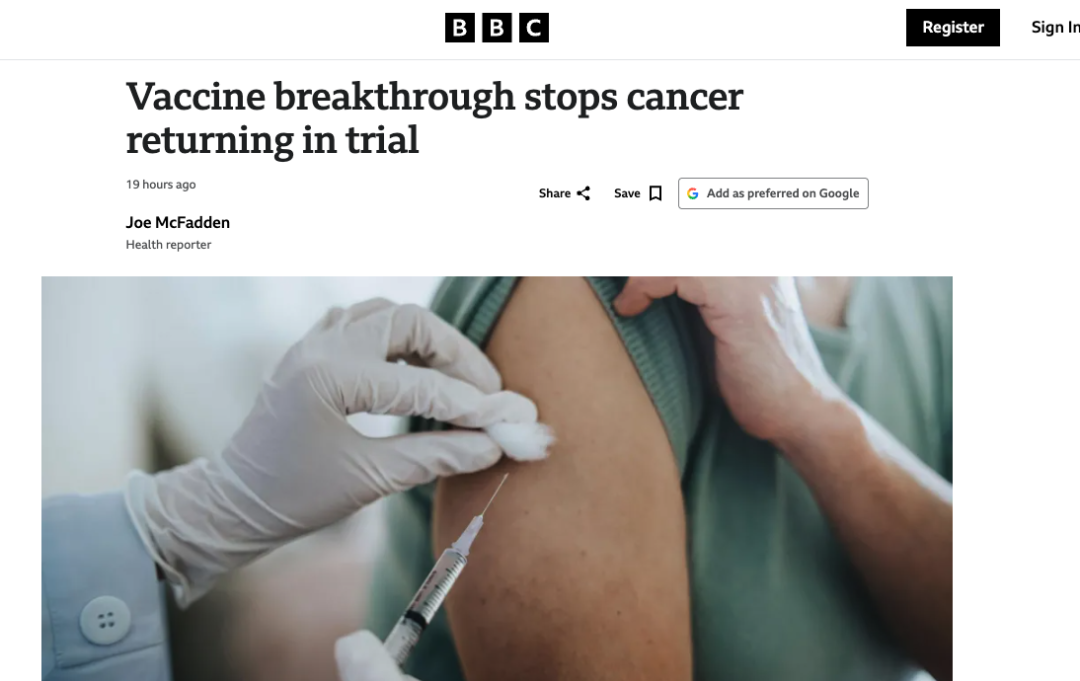
First, let us be clear: this is not the same kind of vaccine we received as children.
It is not an injection given in advance to prevent cancer. The patient already has cancer; after surgery removes the tumour, a vaccine is made specifically for that person using their cancer cells.
The process is quite interesting.
The tumour is first sent for genetic sequencing to identify the mutations in the cancer cells.
A set of neoantigens most worth showing to the immune system is then selected, and that information is encoded in mRNA. V940 can encode up to 34 such tumour neoantigens.
Once administered, the mRNA does not alter a person’s DNA.
The simplest way I can explain it is this:
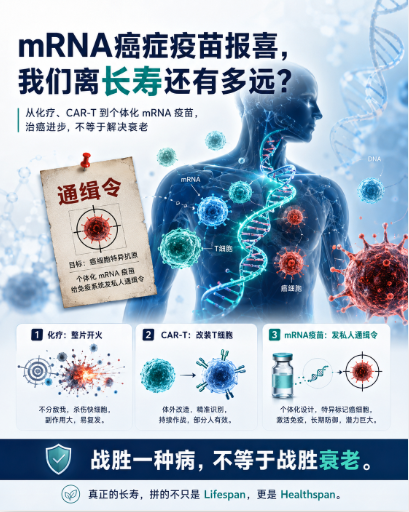
It is like issuing the immune system with a personalised wanted notice for the cancer cells.
It tells T cells:
When you see cells carrying these features in future, watch them closely.
At the same time, Keytruda, or pembrolizumab, is added to release the PD-1 immune “brake”.
One tells the immune system whom to attack; the other tells it that it may attack.
It is an elegant idea.
But even here, we should not leap straight to “cancer has been conquered”.
This Phase 3 result is certainly good news: among 1137 patients whose high-risk melanoma had been completely resected, V940 plus Keytruda met the primary endpoint of recurrence-free survival compared with Keytruda alone, and also met the key secondary endpoint of distant metastasis-free survival.
The problem is that what has been announced so far is still topline results.
How much was the absolute risk reduced? Which patients benefited most? Will overall survival ultimately improve meaningfully? We still need to wait for the full data to be formally published.
The earlier Phase 2b data have now reached 5 years of follow-up: the risk of recurrence or death was reduced by about 49%, and the risk of distant metastasis or death by about 59%.
So my view is:
It is fair to say “very promising”; saying “the cancer vaccine has succeeded” is still a little premature.
If we imagine cancer treatment as catching criminals
An individualised mRNA cancer vaccine sounds complicated, but a rough analogy makes it easier to understand.
Imagine that the human body is a city.
Cancer cells are criminals hiding in the crowd.
Many older anticancer treatments, especially chemotherapy, are a little like opening fire on an entire neighbourhood to eliminate the criminals.
Many criminals are indeed killed, but ordinary residents are caught in the crossfire too.
Why can chemotherapy cause hair loss, bone-marrow suppression and nausea?
Because it does not kill only cancer cells. Some normal cells that divide rapidly are injured as well.
Of course, we now have many targeted and immune therapies that are far more precise. It would be wrong to describe every cancer treatment as indiscriminate bombardment.
But the analogy does help show how the direction is changing.
CAR-T takes the “police” out for modification
When people hear about an mRNA cancer vaccine, many may think of CAR-T.
The two do have something in common.
Both use the patient’s own immune system, and both have a strong element of personalisation.
What they personalise, however, is different.
CAR-T is more like this:
Take the city’s police officers—the T cells—outside, retrain them, equip them with purpose-built gear for recognising the criminals, and then send them back into the city to make arrests.
These “police officers” are already part of the immune system.
CAR-T equips the T cells with an artificially designed receptor, making it easier for them to recognise certain tumour cells.
The more established CAR-T treatments mainly target relatively fixed markers such as CD19 and BCMA.
In other words:
The troops are yours, but the “enemy list” is not necessarily designed around your individual tumour.
An mRNA cancer vaccine is more like issuing a personal wanted notice
An individualised mRNA cancer vaccine works in almost the opposite direction.
It does not require the T cells to be taken out and modified.
Instead, the patient’s cancer cells are analysed for their particular mutations, and those mutations are used to prepare a wanted list specifically for that person’s immune system.
Put simply:
Many older chemotherapy regimens bombarded the neighbourhood to catch the criminals.
CAR-T takes the police out for modification, then sends them back to catch the criminals.
An individualised mRNA cancer vaccine gives the entire police force a personalised wanted notice.
Real medicine is, of course, far more complex.
But the direction is increasingly clear:
Cancer treatment is gradually shifting from “kill as much as possible” to “recognise the target more accurately”.
How far has CAR-T come?
CAR-T is no longer merely a laboratory concept.
It has become an important treatment for certain leukaemias, lymphomas and multiple myeloma.
Some patients who once had very few treatment options can even achieve long-term remission.
But CAR-T has faced one major problem for years:
It works quite well in blood cancers; solid tumours are difficult.
The reason is not hard to understand.
Targets in blood cancers can be relatively “clean”.
Good targets are much harder to find in solid tumours.
If normal tissues also carry the target, CAR-T may attack normal cells as well.
The T cells must also be able to enter the tumour.
Solid tumours are hypoxic, structurally complex and filled with signals that suppress immune responses.
Even when CAR-T cells get there, they may soon become unable to fight effectively.
This situation, however, has begun to change.
In 2026, China approved satri-cel for some CLDN18.2-positive advanced gastric and gastro-oesophageal junction cancers.
This is regarded as an important step for CAR-T into the treatment of solid tumours.
But I do not think we need to overstate it.
It is more like opening a crack in the door.
We are still a long way from a future in which every solid tumour can be solved simply by taking out a few T cells, modifying them and putting them back.
If cancer becomes increasingly treatable, will people live longer?
This is the question I found even more interesting after reading the news.
Suppose that one day mRNA vaccines, CAR-T and immunotherapy become much more powerful, and many cancers can be controlled or even cured.
Will people then live to 100?
Probably not so simply.
Cancer is only one large part of what kills us.
Another large part is cardiovascular and cerebrovascular disease.
Blood vessels will still age.
Atherosclerosis will still develop.
As plaques accumulate, myocardial infarction, stroke and heart failure will still arrive.
Even today, cardiovascular disease remains among the world’s largest causes of death, killing close to twenty million people each year.
So even if we one day turn many cancers into chronic conditions, or cure them, another challenge awaits those who reach their eighties and nineties.
The brain.
Alzheimer’s disease, vascular dementia, Parkinson’s disease and other neurodegenerative diseases will not disappear automatically because cancer has been cured.
Tens of millions of people worldwide are already living with dementia.
For many older people, what is truly frightening may not be death itself, but gradually losing memory, judgement and the ability to live independently over their final decade or more.
Medicine has a concept called competing risks.
In simple terms:
Fill in one pit, and people live long enough to have more chances of falling into the next.
More than a century ago, many people died from infections.
Once vaccines, antibiotics and public health pushed that obstacle further back, cancer and cardiovascular disease gradually became the leading problems.
If cancer is pushed back again in future, the next challenges are likely to be dementia, organ ageing, sarcopenia, immune ageing and the steady loss of the body’s overall reserves.
That is why I increasingly think that “longevity medicine” is unlikely to arrive as a single miracle drug.
It looks more like a campaign fought on many fronts.
The cancer must not return.
The blood vessels must not become blocked.
The heart still has to pump.
The brain should remain clear.
Muscle must not be lost too quickly.
And the immune system cannot retire early.
Miss any one of these, and the plan may fail.
mRNA, CAR-T and gene therapy may eventually blend together
So the question:
Which is more powerful—mRNA, CAR-T or gene therapy?
No longer seems very interesting to me.
These technologies are already beginning to borrow one another’s tools.
A PCSK9 gene-editing study published in the New England Journal of Medicine this year is a good example.
Researchers used VERVE-102 to treat people with high cholesterol.
The treatment itself used mRNA.
After the mRNA entered liver cells, it temporarily produced a base editor. A guide RNA then carried that editor to the PCSK9 gene and switched the gene off.
This is what makes it so interesting:
mRNA temporarily makes the tool; gene editing makes the actual change to DNA.
The mRNA soon disappears.
But the genetic change left behind is intended to last for a long time, perhaps permanently.
This was an early Phase 1 study with only 35 patients, so it remains a long way from routine use.
Yet in the highest-dose group, PCSK9 fell by an average of about 88% and LDL by about 62%—enough to warrant attention.
Future medicine may increasingly look like this:
- AI helps analyse your tumour, genes and risks
- mRNA makes proteins or therapeutic tools when needed
- cancer vaccines teach the immune system whom to recognise
- CAR-T turns immune cells directly into fighting units
- immunotherapy releases the immune system’s brakes
- gene editing changes clearly defined disease-causing targets
- cell therapy helps replace tissue that has already been damaged
In the end, these technologies may not replace one another.
They are more likely to be used together.
But even if we can treat cancer, cholesterol and genes, how long do we actually want to live?
This may be the harder question.
If someone lives to 100 but spends the final 15 years unable to recognise family, walk, eat or bathe without help, that is certainly still “longevity”.
But it may not be the longevity most people truly want.
By contrast, someone who lives to 85, and after 80 can still walk, travel, eat, chat and think clearly, may be closer to many people’s ideal.
That is why I now prefer the concept of healthspan to lifespan.
The question is not simply:
“How many years did you live?”
It is:
“During how many of those years could you still live like yourself?”
The positive Phase 3 news for this mRNA cancer vaccine is genuinely encouraging.
CAR-T is also beginning to move gradually from blood cancers into solid tumours.
Gene editing is even being tested as a way to alter genes that affect cardiovascular risk directly.
Each of these developments is impressive in its own right.
But between curing cancer and truly solving “longevity” lie the heart, blood vessels, brain, muscles, immune system and ageing itself—which we still do not properly understand.
So when I now see news described as a “breakthrough”, my first thought is no longer:
Are humans close to becoming immortal?
I am more interested in this:
If one day we really can live longer, can we help the body and brain keep going for a few more years too?
The cancer challenge may be becoming easier to fight.
Many more challenges follow.
Sources and scope notes
The following authoritative pages were checked during import to clarify the policies, medical guidance or professional rules discussed; they do not constitute an endorsement of every view in the article.
- Merck and Moderna phase-three topline release; full effect sizes and overall-survival data remain pending
- Shanghai Pudong government approval notice; applies only to the stated heavily pretreated gastric and gastro-oesophageal junction cancer population
- New England Journal of Medicine early dose-escalation study; not evidence of routine use
Be the first to add a thoughtful comment.