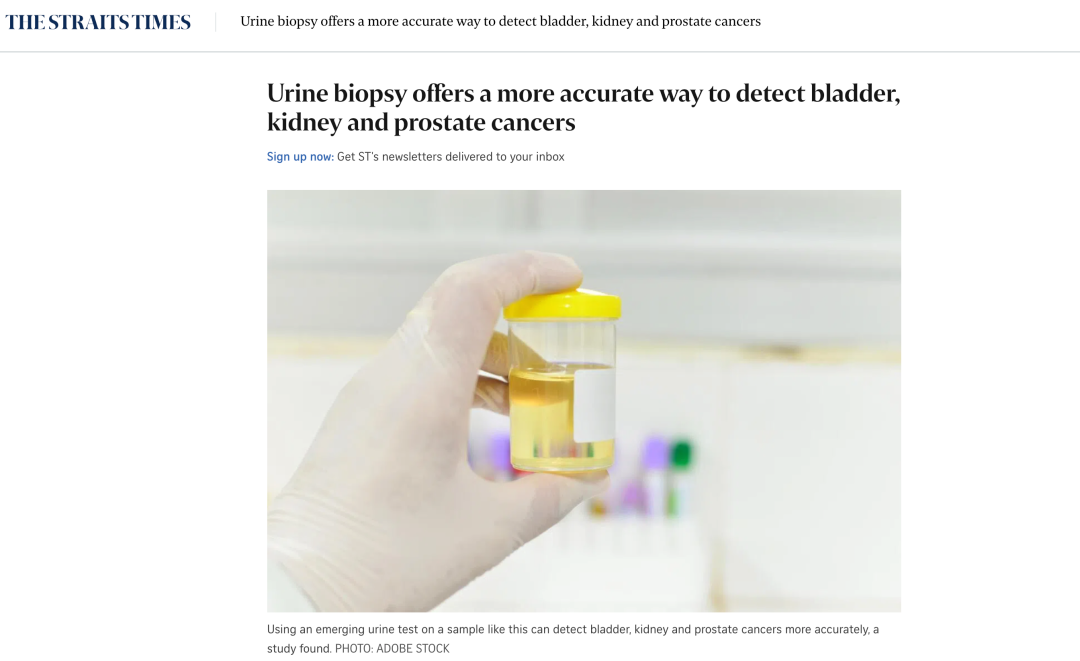
I recently saw a news report about “urine biopsy”.
An early study in Singapore is trying to find fragments of DNA and RNA shed by tumours into urine, using them to detect bladder, prostate and kidney cancers.
The study included 120 people. The urine test achieved a 92.3% detection rate for bladder cancer; after RNA analysis was added, the detection rate for prostate cancer also improved. But its sensitivity for kidney cancer was only 14.3%.1
So, for now, do not interpret this as an established cancer-screening test. The sample size is still small, performance varies greatly between cancers, and larger-scale clinical validation is still needed.
The core technology is liquid biopsy, which does not necessarily depend on AI.
But it made me think of a question:
In the future, will what we call a “medical examination” still be limited to blood tests, urine tests and X-rays?
A biomarker does not have to be a single number
In the past, when we spoke of biomarkers, we usually thought of blood glucose, cholesterol, troponin, PSA or a particular genetic mutation.
These indicators are relatively clear and easy to measure.
But the health information generated by the human body every day goes far beyond the handful of numbers on a laboratory report.
Whether a person’s speech has become slurred, whether their walking speed has slowed, whether the rhythm of their heartbeat and breathing has changed, what their retinal blood vessels look like, whether their sleep is becoming increasingly fragmented, and even subtle changes in the colour of their skin and mucous membranes may all be relevant to health.
These signals did not suddenly appear. In the past, they were simply difficult to measure consistently.
A doctor can see when someone is obviously pale or has an obviously unsteady gait. But it is difficult to track extremely subtle changes over several months, and impossible to simultaneously analyse hundreds of thousands of pixels in a photograph and frequency changes in a voice recording, then calculate them together with medical history, blood pressure and age.
AI really is better than people at this kind of work.
It can search large datasets for patterns that are hard for the human eye to detect. It can also combine several signals that appear to have little value when considered separately.
Of course, finding a pattern is not the same as finding a disease. That distinction is important.
A retinal photograph may reveal more than the eye
The retina is one of the few places in the human body where blood vessels and neural tissue can be observed directly.
Clinically, retinal photographs are mainly taken to check for diabetic retinopathy, glaucoma and macular disease. But researchers have found that deep-learning models can also estimate age, blood pressure, smoking status and some cardiovascular risks from retinal images.
A study published in Nature Biomedical Engineering used data from more than 280,000 people to train a model, then validated it in two other independent datasets.2
This does not mean that one retinal photograph will replace blood tests, electrocardiograms and other examinations in the future.
More accurately, a photograph may contain information related to whole-body health that a doctor cannot see with the naked eye alone.
The same idea can be applied to skin images, facial changes, voice, gait and data collected by smartwatches.
A voice recording may also contain signs of neurological change
Canadian high school student Matthew Shen helped develop a voice-analysis model to identify features of early Parkinson’s disease. The related research was published in Scientific Reports.3
The system does not simply listen to whether a voice is high or low. It analyses multiple acoustic features, including MFCC, jitter and shimmer. The study used 81 voice recordings and reported a model accuracy of about 91.1%.3
Ninety-one per cent sounds impressive, but 81 samples are indeed too few to show that the system is ready for clinical diagnosis.
What I find more interesting is the question it raises:
Could changes in a person’s stability of pronunciation, vocal-cord vibration and intonation appear before an obvious tremor?
In the future, this method may be better suited to long-term observation than to making a diagnosis from a single recording.
For example, with the patient’s consent, the patient could regularly record a fixed passage. If the system finds that the voice is persistently deviating from its previous state, it could prompt the patient to seek further assessment.
That is far more practical than directly telling a patient, “You may have Parkinson’s disease.”
The room itself may become a sensor
Some studies are also trying to use Wi-Fi or other radio-frequency signals for contactless activity monitoring.
When a person walks, sits down, stands up or falls in a room, their body affects how wireless signals travel. Researchers analyse these changes and ask models to determine what the person is doing.
Related studies have already attempted to identify walking, sitting, standing and falling, and are also exploring activity monitoring in non-line-of-sight environments.4
It sounds a little like science fiction, but it does have practical uses in eldercare.
After an older person falls, the problem is often not that the family does not know how to respond. It is that family members and carers do not know the person has fallen at all.
Cameras raise privacy concerns, while wearable devices may be forgotten, left off or left uncharged. If wireless-signal monitoring becomes accurate enough, it may be able to detect an older person suddenly falling, remaining out of bed for an unusually long time or walking progressively more slowly, without recording images of daily life.
Of course, handling false alarms, determining whether the technology works across different home layouts and identifying individuals when several people are present are not simple problems.
Medical examinations may shift from a snapshot to long-term observation
Many medical examinations today show only a single point in time.
We draw blood once a year, measure blood pressure every few months and arrange scans only after symptoms appear.
But many diseases do not suddenly appear on one particular day. The body changes gradually over months and years.
For an individual, the most valuable signal may not be that a number has just crossed the “normal” threshold. It may be that the person is steadily moving away from their own previous state.
For example, an older person who has always walked relatively slowly may not have a problem. But if that person has walked progressively more slowly over the past three months, stands up less often and shows obvious changes in nighttime activity, that group of changes may deserve more attention than a single measurement.
The biomarkers of the future may no longer be single values. They may be patterns that change over time.
Urine, voice, images, gait, heartbeat, sleep and medical history considered together may detect abnormalities earlier than any one indicator. Multimodal medical research is moving in this direction.5
AI can easily find patterns; the hard part is proving that they are useful
This is also where I am most cautious about medical AI.
AI can analyse tens of thousands of features at once and will always find some correlations. But those correlations may not be clinically meaningful. The model may simply have memorised the characteristics of a particular dataset.
A model may perform very well in one hospital, then deteriorate immediately when used in another country, age group, device or environment.
Voice is affected by language and accent. Skin colour is affected by lighting and skin tone. Gait is affected by joint disease. Blood-oxygen readings may also be affected by the device and the way they are measured.
After a model is deployed, the patient population and clinical workflow may change, causing accuracy to decline gradually. This is data drift.
The US Food and Drug Administration has proposed that evaluating an AI-enabled medical device should not focus only on its accuracy during development. Its performance in the real world, bias across different populations and safety after integration into clinical workflows must also be observed.6
Privacy cannot be avoided either.
When voice, sleep, gait and household wireless signals can all become health data, who may collect that information? Do patients genuinely know what the system is analysing? Can insurers and employers use it? When the system finds an abnormality, who explains it and who is responsible for the follow-up?
The World Health Organization also identifies privacy, bias, transparency and patient autonomy as core issues in the governance of AI for health.7
AI is better suited to being a translator than a fortune teller
We often imagine AI as a diagnostic machine that is more intelligent than a doctor.
But at this stage, I would rather see it as a translator.
It helps us understand DNA and RNA fragments in urine, find patterns in retinal photographs that the naked eye cannot see, and search for traces of disease in voice, gait, heartbeat and breathing.
Whether these tools are genuinely valuable cannot be judged only by the accuracy reported in papers.
We must also ask whether they can detect problems earlier, reduce unnecessary tests, change treatment decisions and ultimately give patients better outcomes.
The health check-up of the future may not mean drawing several more tubes of blood every year or performing several more scans.
More likely, we will begin to sift genuinely useful signals from the data our bodies naturally leave behind every day.
The body is indeed always leaving information.
But medicine’s task is not to turn every signal into a new source of anxiety. It is to decide which ones are worth listening to, when action is needed and what should be done after something is found.
References
Footnotes
-
The Straits Times. Urine biopsy offers a more accurate way to detect bladder, kidney and prostate cancer. ↩
-
Poplin R, et al. Prediction of cardiovascular risk factors from retinal fundus photographs via deep learning. Nature Biomedical Engineering. 2018;2:158-164. ↩
-
Shen M, et al. Explainable artificial intelligence to diagnose early Parkinson’s disease from voice recordings. Scientific Reports. 2025. ↩ ↩2
-
Tan B, et al. Evaluation of deep learning models in contactless human motion detection system for next generation healthcare. Scientific Reports. 2022. ↩
-
Acosta JN, et al. Multimodal biomedical AI. Nature Medicine. 2022;28:1773-1784. ↩
-
US Food and Drug Administration. Measuring and evaluating artificial intelligence-enabled medical device performance in the real world. ↩
-
World Health Organization. Ethics and governance of artificial intelligence for health. 2021. ↩
Author's note: Personal opinion, for reference only.
Be the first to add a thoughtful comment.