A few days ago, I came across an interesting piece of Singapore news.
Professor Dean Ho of NUS Medicine is 47 this year. Over the past few years, he has done something very characteristic of a researcher: he made himself the subject of an experiment.
He controlled his diet, exercise and sleep; tracked data such as blood glucose, blood lipids, heart rate and sleep over the long term; and tried fasting for about 20 hours daily, including a 48-hour fast.
The media then reported a particularly eye-catching result:
His “biological age” was only 31.8 years.
In other words, roughly 15 years younger than his age on his identity card. (NUS Medicine)
People’s first reaction was not envy.
They looked at the photographs first.
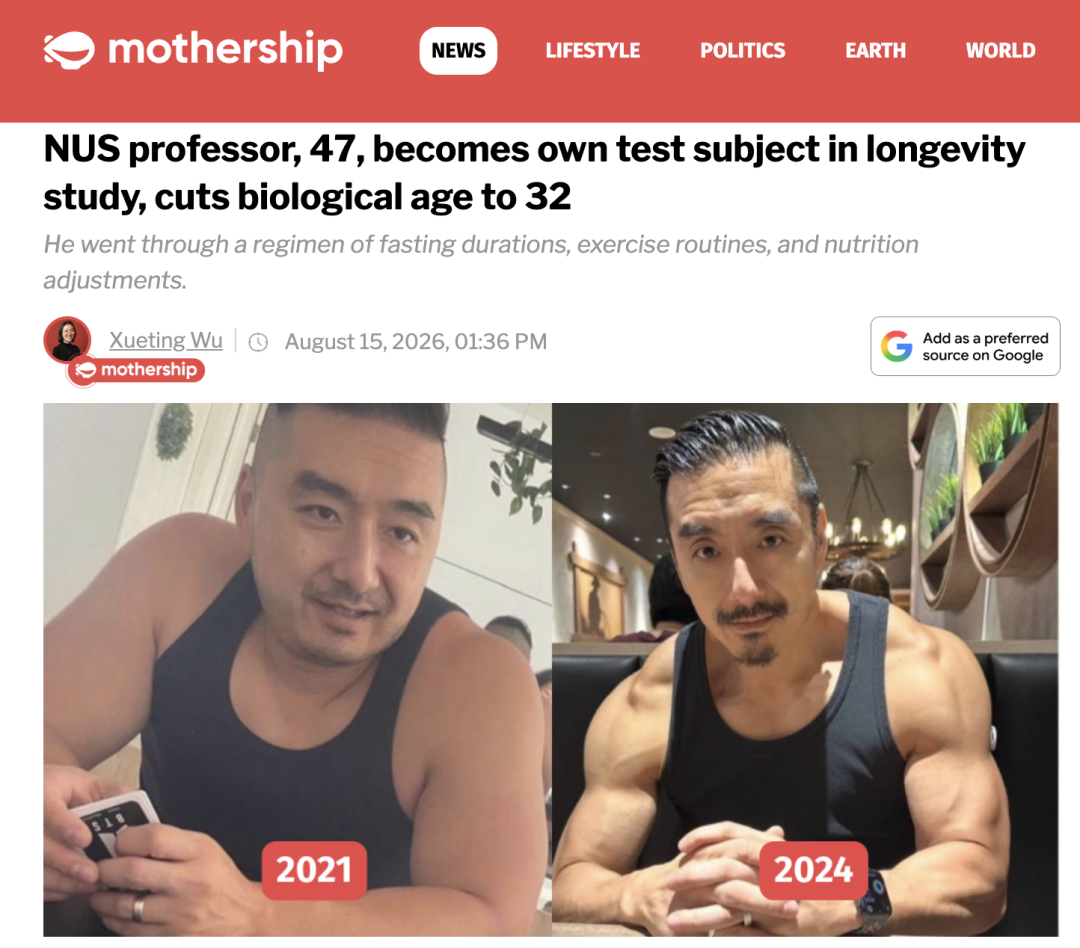
The left image is from 2021 and the right one from 2024.
The comments then quickly turned into a “community medical seminar”:
“His biological age is 15 years younger, so why does he look 10 years older in the photographs?”
Of course, this was mostly a joke.
But it made me think the question was interesting:
When we say someone is “young”, what exactly do we mean?
This “32 years” was not measured directly by a machine
Let us be clear about this first.
The DELTA study was indeed published in PLOS ONE, but it involved just one participant: Professor Dean Ho himself.
In medical research, this is commonly called N=1. (PLOS)
The team tracked his blood glucose, blood lipids, inflammatory markers, sleep, exercise, heart rate, gut microbiome and changes in how his body responded to stresses such as fasting.
The figure of “31.8 years” was not printed directly on a lab report after drawing a tube of blood.
It was estimated using HbA1c, weight, waist circumference, hs-CRP, HDL, blood pressure, pulse and chronological age in a model built from US population data, then calculated by the AI Healthspan Copilot they developed. (PLOS)
The paper itself was careful in its wording.
At present, the finding is mainly exploratory, and this AI system has not undergone prospective validation.
A more accurate description would be:
Using this particular method of calculation, some of his current health indicators resemble those of a younger person.
That is entirely different from saying that science has proved his body has become young again at 32.
But the latter certainly makes a more attractive news headline.
There has never been a single ruler for “biological age”
Longevity medicine now talks a lot about biological age.
The problem is that people are using entirely different rulers.
Some look at routine laboratory measures such as blood glucose, blood lipids, inflammation, liver function and kidney function.
Some measure DNA methylation, the so-called “epigenetic clocks”.
Others look at proteins, metabolites and the gut microbiome.
Going further, people now use brain MRI, chest X-rays, wearables and even facial photographs to estimate age.
npj Aging has even published a commentary asking a very direct question:
Do we really need so many ageing clocks? (Nature)
Different models may not be measuring the same thing at all.
So I have always felt that biological age can be a reference, but we should not treat it as something magical.
There is no hidden number inside the body waiting to be measured.
Biological age is really just a way of putting many complex things into a formula and producing a number that is easier to understand.
Its strength is that it is simple.
Its weakness is also that it is too simple.
Since becoming a GP, I have cared more and more about some very ordinary things
For example, a 70-year-old person comes to the clinic.
Their blood pressure is good, blood glucose is stable, and their mind is clear.
They can walk, buy groceries and travel; rise from a chair without support; still have reasonable muscle strength; sleep at night; and have friends to talk to.
Another person has every “anti-ageing marker” looking excellent.
But they become breathless after climbing two storeys, their legs are getting thinner, they have chronic insomnia, they take twenty types of supplement every day, and their whole life revolves around:
“I must not get old.”
Which person is younger?
I genuinely do not think a blood test can answer that question.
In clinical practice, when we assess older people, we often care greatly about grip strength, walking speed, balance, cognition and heart-lung function, as well as one very practical question:
Can you still live independently?
Some newer DNA methylation studies are moving in this direction too. Instead of only telling you what age you resemble, they attempt to predict cognition, mobility, psychological wellbeing, sensory function and vitality. (Nature)
Because as people grow older, what truly affects daily life is not that number.
It is whether you can still do the things you want to do.
Reaching 100 does not necessarily mean the “longevity” we imagine
WHO’s description of healthy ageing contains a very practical idea.
The point is not for a person to have absolutely no illness in old age.
In fact, having no illness at all in one’s seventies or eighties is not especially realistic.
What matters more is whether you retain the ability to move, think, learn, care for yourself, relate to others and participate in society. (World Health Organization)
To me, that definition is closer to what ordinary people really want than a biological age of 32.
If someone lives to 105 but spends the final 20 years completely bedbound, having lost cognition and the ability to live independently, that is still longevity.
But it is probably not the longevity most people imagine.
The reverse is true too.
If someone is exceptionally healthy before 55, eats, drinks and enjoys life every day with perfect quality of life, then suddenly dies of a heart attack at 55, we would probably not comfort ourselves by saying:
“It is all right; at least his quality of life was high.”
So lifespan and quality of life are not an either-or question.
What we really want is probably this:
To live a little longer, while postponing the period when the body breaks down as much as possible.
That is what is now commonly called healthspan.
As for Professor Dean Ho, the truly valuable part is not “32 years”
I do admire his willingness to experiment on himself.
But not because of that 31.8.
What interests me more is that he increased his sleep from around five hours to close to eight hours, lowered his resting heart rate from 65 to 46, regularised his diet and kept up his exercise. (NUS Medicine)
These are real changes, whether the AI ultimately tells him he is 32, 42 or 52.
As for fasting for 20 hours daily, occasionally fasting for 48 hours, and training for 90 minutes daily, ordinary people do not need to copy this immediately after reading the news.
He is conducting research.
For ordinary working people, the morning is for sending the children out, the day is for work, and the evening brings a second shift at home.
If we can get enough sleep, move a few times each week, manage our blood pressure, blood glucose and cholesterol, avoid smoking, and avoid becoming excessively overweight, that is honestly already a very good “longevity plan”.
Whether a photograph makes someone look younger or older should certainly not be a medical indicator.
Different lighting, a little loss of body fat, a longer beard, a tan or a different hairstyle can all make a person look several years different.
If a child happened to wake you three times the night before, then you took an identity-card photo the next morning, you might look a full decade older.
So after reading this news, what I really want to discuss is not:
Has Dean Ho really become 15 years younger?
It is three very ordinary questions:
What is youth?
What is health?
What kind of longevity do we actually want?
My own answer is not very high-tech.
It is simply to live a little longer and fall ill a little later.
To still be able to walk and eat independently in one’s seventies or eighties, and go wherever one wants to go.
To still have a few people who want to share a meal and conversation with you, and still have something you want to do.
Whether your identity card then says 70, while AI says 55 or 65,
I do not think it matters that much.
Be the first to add a thoughtful comment.