I saw a news report this morning.
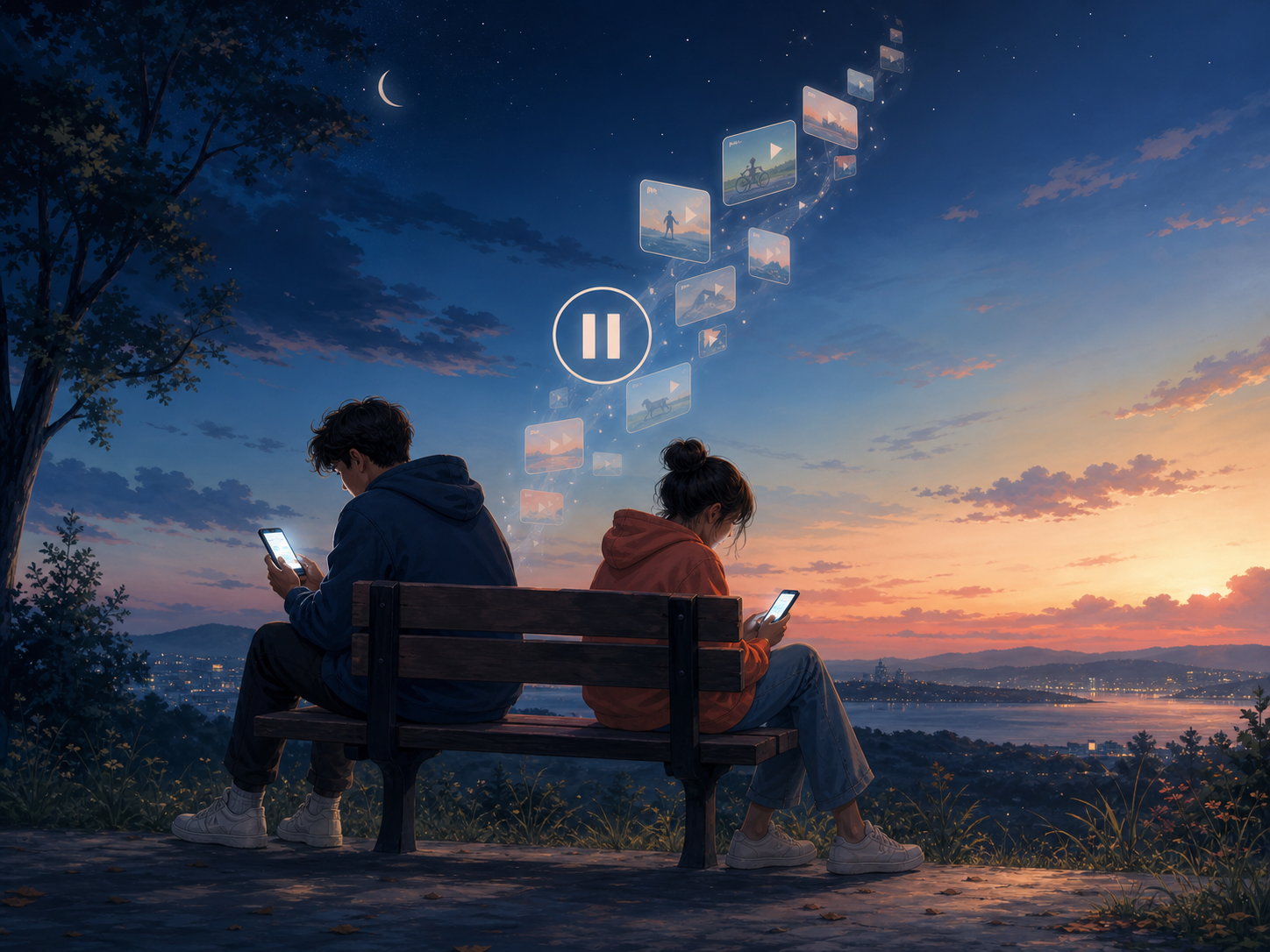
The United Kingdom plans to set social-media use restrictions by default for young people aged 16 to 17, from midnight to 6 in the morning, while also turning off autoplay.
It made me think of a question:
Have we begun to treat social media as something whose dose needs to be controlled?
Of course, it cannot be equated directly with cigarettes or alcohol.
But social media does steadily consume people’s time and attention.
Many short videos leave nothing behind
I scroll through short videos too.
I only meant to rest for five minutes; when I came to, half an hour had gone.
The first clip reports medical news, the second teaches you how to achieve financial freedom, the third analyses why a stranger got divorced, and finally there is a cat falling into a cardboard box.
Taken on its own, none of them seems especially boring.
But after putting down the phone, nothing remains in my mind.
I have neither truly rested nor learnt anything.
The time has simply passed.
Sometimes I call this state “entertainment while waiting to die”.
That may sound a little harsh, but it feels very real.
You sit there without anything particular you want to watch, simply being led by the algorithm, scrolling down one clip after another.
Of course, there is nothing wrong with entertainment.
Doctors can watch cats after work too, and parents can collapse on the sofa and scroll through some empty content after getting their children to sleep.
The question is whether you are still in control of that entertainment.
Watching actively for ten minutes and scrolling unknowingly for two hours are not the same thing.
In the former, you are using the platform.
In the latter, it is more like the platform is using you.
Short videos are not without value
I do not agree with calling all short videos rubbish.
Some videos really can explain complex matters clearly, and may help someone discover a question worth investigating further.
I too come across leads on healthcare, AI and clinic management in short videos, then look for the original sources to verify them.
So the question is not whether short videos are useful.
It is whether they are useful to you now.
A video about diet for diabetes may be very practical for someone controlling their blood glucose. For someone else, it may only create health anxiety.
An interview about entrepreneurship may inspire a business owner. For someone who has already been working overtime until midnight, it may simply be another form of mental overtime.
During the day, you may need professional information.
At eleven at night, what you may really need is sleep.
The platform’s AI knows you well, but may not be on your side
Short-video platforms have long been using AI.
It knows which frame makes you pause, which headline makes you tap in, and what content makes you angry, anxious, or keep scrolling.
Sometimes, it may understand your weaknesses better than you do.
But platforms mainly optimise for time spent.
How long you watched, whether you will keep scrolling, and whether advertisements can be shown a few more times.
What ordinary people truly want, though, may be sleep, focus, health, work efficiency, or a proper meal with their children.
These aims often conflict.
The platform wants you to keep watching.
Your body wants you to sleep earlier.
The most troubling part is that platforms are getting to know us better and better.
It is just that this knowledge is mainly used to keep us there for longer.
Do we need an AI that is on our side?
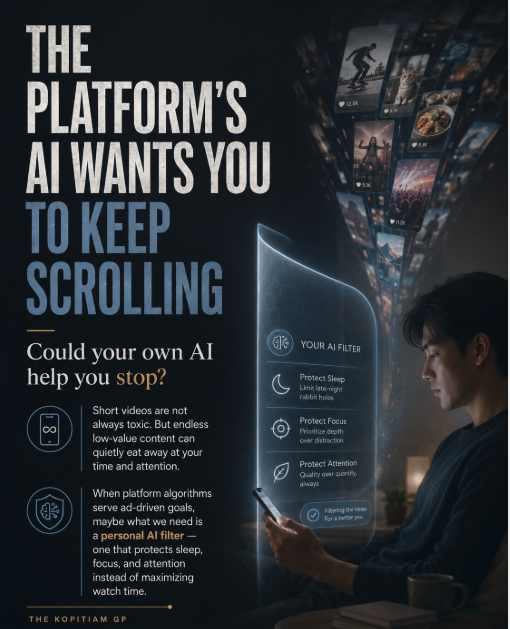
I have often wondered whether an AI might one day emerge that does not help platforms retain users, but helps users filter platforms.
It does not ask:
What should be recommended next so that you keep watching?
It asks:
Is this content genuinely useful to you right now?
For example, I am a GP and I am usually interested in healthcare AI, clinic management, ageing, longevity and Singapore policy.
This AI could help me retain content that genuinely contains useful information.
It could skip content with exciting headlines but highly repetitive substance.
If I have already seen the same idea more than ten times, it could remind me:
You have already seen a similar version of this. There is no need to waste another minute.
After eleven at night, it could stop endless recommendations and allow only active searches.
After twenty minutes of scrolling, it would not merely tell you that you “used your phone for two hours today”, but remind you:
You have just watched 23 videos. Most contained no new information. Do you still want to continue?
This kind of reminder may be more useful.
Because it does not merely count time; it also helps you judge what that time has actually brought you.
It must not become another “digital parent”
Such an AI would of course have problems too.
The first is privacy.
To truly understand you, it might need to know your viewing history, occupation, interests, daily routine and even changes in mood.
Who keeps this information? Could it eventually be used to sell advertising again?
If an AI that claims to protect you still earns its income from advertising, I would be rather sceptical.
Another problem is the information cocoon.
If AI retains only content that is “useful to you”, people may encounter unfamiliar viewpoints less and less often.
Besides, not everyone needs to keep studying, exercising, investing or improving their understanding after work.
Sometimes, watching a few boring videos is simply a way to switch off, and there is nothing wrong with that.
So an ideal AI filter should not decide for you what is worth watching.
It only needs to remind you:
Are you choosing actively right now, or have you been carried away by the algorithm again?
What really needs protection is attention
I do not think short videos themselves are poison.
Nor do I believe restricting social media can solve young people’s sleep, learning and mental-health problems.
Behind these problems are family, school and real-life pressures too.
But I increasingly feel that attention should also be treated as a health resource.
We manage blood glucose, blood pressure and cholesterol.
Yet we rarely seriously calculate how much of our time each day we hand over to algorithms without realising it.
Then, when evening comes, we feel there is never enough time.
Very often, it is not that there truly is too little time.
It has simply been scrolled away, one clip at a time.
An AI that is genuinely on the user’s side should not only know what you like to watch.
It should also dare to remind you:
You do not need to watch this one.
Be the first to add a thoughtful comment.